


Mike Potter: Government must stop writing lessons learned and start acting on them
 Tim Coulthard
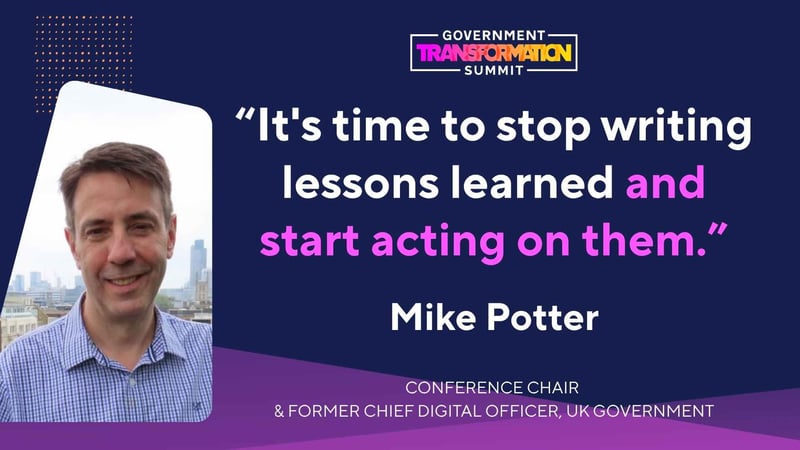
Ahead of chairing Government Transformation Summit on 25 June, former UK Government Chief Digital Officer Mike Potter joined us to reflect on what more than a decade of digital transformation has achieved, and where government still needs to go next.
His verdict is clear - government has no shortage of lessons, reports or recommendations, but the real challenge is turning them into action. "I think it's time to stop writing lessons learned and writing the same things down every time," he says. "It's time to start acting on them."
That call for more proactive and ambitious transformation programmes is a theme that will underpin many of the conversations he hopes to provoke at the Summit. While he is eager to hear about the latest innovations taking place across government, he is equally interested in understanding how organisations are learning from both success and failure.
"We do have a long history of transformation that hasn't worked. We've got lots of things that have worked well, but I don't think we're very good at learning from those things that haven't worked and applying those lessons."
For Potter, transformation success starts long before technology enters the discussion. It begins with creating the right conditions for change.
He points to a series of factors that consistently influence outcomes: retaining ownership of transformation rather than outsourcing it, delivering value incrementally, building trust through visible progress, creating strong communities of practice and ensuring leaders actively protect the environment their teams need to succeed.
Ultimately, he believes government needs to spend less time focusing on transformation as a technical challenge and more time understanding it as a leadership challenge. "It's not just about skillsets. It's fundamentally about mindset as well," he says
Changing the conversation
That shift in thinking reflects how the digital agenda itself has evolved over the past decade. The conversation has moved beyond technology and into questions of culture, organisational design and continuous improvement.
"The great thing about the shift from IT to digital is that we've made a shift from a conversation about technology to a conversation about culture," Potter says.
He argues that transformation is too often treated as a programme with a defined start and finish. Instead, organisations should focus on building enduring capabilities that allow them to evolve continuously as citizen needs, technologies and policy priorities change.
"Transformation was often seen as a thing with a start and a finish," he says. "Increasingly it becomes a conversation about continuous evolution."
That perspective also shapes his view of the progress government has made so far. Potter believes the past decade has delivered significant improvements in the way citizens interact with government. Initiatives such as GOV.UK and the wider service design movement have fundamentally changed public expectations of digital services.
"What citizens see and experience is a fundamentally different interaction with government, which is great."
However, he argues that the harder work still lies ahead: "What we didn't transform was the enterprise core."
Transformation: an ongoing journey
Behind many modern public services sits a complex landscape of legacy technology, outdated processes and long-standing delivery practices. While some organisations have successfully modernised these foundations, Potter believes government as a whole still needs to complete that journey.
He points to examples such as the Passport Office, where wholesale transformation of technology, delivery models and organisational practices has helped improve service quality and innovation. The challenge now is scaling that success across the wider public sector. "We need to finish the job across the entirety of government," he says.
One reason progress can be difficult is that many of government's barriers are self-imposed. The public sector has developed a range of controls, governance mechanisms and safeguards designed to manage risk and protect public money. While their intentions are sound, Potter believes the cumulative effect can often constrain innovation and delivery.
"These well-intended guardrails create unintended consequences."
He cites examples ranging from programme-based funding models to procurement processes that make it difficult for innovative, smaller suppliers to work with government. Many of these structures were designed for a different era and can struggle to support modern product-based delivery approaches.
The answer is not to abandon governance, he stresses, but to redesign it. "We need to move fast, but we can also move safely,” he says.
That challenge extends beyond government itself and into its relationship with suppliers. Potter is notably direct when discussing what he believes needs to change in the technology and consulting market. For too long, he argues, some suppliers have prioritised creating dependency over creating value. Instead, he wants to see relationships built around expertise, innovation and genuine partnership.
"Differentiate your capability and expertise so that we want to keep working with you, not make it hard for us to leave you."
He believes artificial intelligence will accelerate this shift, particularly for consulting and software delivery businesses whose traditional operating models are already coming under pressure.
"Work with us and thrive, or try to defend your existing practices and models and you will not survive."
While AI dominates many current discussions about transformation, Potter takes a measured view of where the technology is heading.
Taking AI beyond trials
Government, he argues, has largely completed the experimentation phase. The priority now is scaling successful use cases and delivering measurable benefits. He identifies three major opportunities. The first is improving workforce productivity by allowing public servants to focus on higher-value work. The second is fiscal productivity, helping government tackle challenges such as fraud, error and debt. The third is capital productivity, using AI to make better investment decisions around infrastructure, maintenance and public assets.
Taken together, he believes these opportunities could unlock benefits that extend far beyond efficiency savings.
As chair of Government Transformation Summit, these are exactly the types of conversations he hopes to encourage. Not abstract debates about technology for technology's sake, but practical discussions about leadership, delivery, learning and impact.
For those considering attending, Potter sees the event as an opportunity to accelerate personal and organisational learning. "The value and power of coming along to an event like this is it's an opportunity to accelerate that learning."
His advice is simple: arrive with an open mind, share experiences honestly, learn from peers and build connections that continue long after the event ends. After all, as he puts it, learning should never stop. "I learn something new every day."
For government leaders navigating an increasingly complex transformation agenda, that may be the most important lesson of all.