

Apres moi, le deluge: Danny Kruger on Reform’s 'Fixing the Centre' plan
 James
James
 From Dominic Cumming's "hard rain", to Sir Keir Starmer's "tepid bath of managed decline " - the waters surrounding the Civil Service have been getting choppy.
Prime Minister Andy Burnham has also waded into the deep end, referring to improving “the flow of power” and how Number 10 North, its responsibility for the government’s growth agenda and a more powerful Cabinet Secretary will “break through the logjams” holding up delivery.
The metaphors may be watery, but the political conclusion is solid. The Overton window of feasible Civil Service reform has shifted decisively: the question being posed by politicians is no longer whether Whitehall needs to change, but how far and how fast?
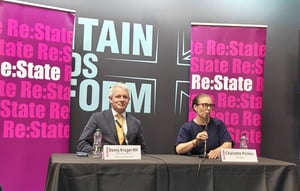
Last week we headed up to Birmingham to hear Danny Kruger MP, Reform UK's Head of Preparing for Government, talk through his reorganisation plans - 'Fixing the Centre' - setting out a stark vision of why and how the Civil Service needs to change.
Fixing the centre by taking it apart
“The Cabinet Office does everything. It is the repository of all sorts of funny little functions. It also man-marks and duplicates a lot of the policy functions that should be done by departments. It is an amorphous mess.”
The paradox, in Kruger's telling, is a centre that feels “underpowered, over-centralised, too large and impotent all at the same time”.
This lies at the heart of Reform’s Fixing the Centre plan: Kruger would abolish the Cabinet Office and the post of Cabinet Secretary, replacing them with an Office of the Prime Minister and a non-ministerial Department of the Civil Service.
“Better pay, smaller headcount, more reward for high performance and more expectation of delivery.”
The Cabinet Secretary’s current responsibilities would be divided three ways: a political Chief of Staff would be the Prime Minister’s principal policy adviser and gatekeeper; a political Chief Secretary would run the flow of Cabinet business and a domestic policy secretariat; and an externally-recruited chief executive would lead the new Civil Service department and become Head of the Civil Service, with a mandate to reduce headcount, improve productivity and drive AI adoption.
“We would separate out the functions that the Cabinet Office does into its proper components and we’re going to scrap the office of Cabinet Secretary,” Kruger said. “I think that century-long post has served its term and we need to create a new centre.” The Civil Service department, he added, would be led by a “proper CEO” from outside government with real-world experience of transforming large organisations.
Kruger says the Cabinet Office has grown from a small secretariat into a group employing more than 11,000 people. The precise total depends on which arm’s-length bodies and agencies are counted - which rather reinforces his point about blurred boundaries.
But the real test is not whether Reform can dismantle the Cabinet Office; it is whether the replacement could be smaller without becoming weaker, or simply becoming a more politicised version of the same centralising instinct.
Not everything would be swept aside: Reform’s plans retain a career Permanent Secretary in the Office of the Prime Minister. Its domestic secretariat would mix special advisers and civil servants. Departments would regain responsibility for policy and delivery, rather than becoming branch offices of Number 10. Ministers, in turn, would have greater power to appoint and dismiss Permanent Secretaries and choose the officials around them.
“Managing trade-offs is the business of politics, and we need more politics, not less,” Kruger says.
The centre would set priorities, co-ordinate policy and delivery, track results and send specialist teams into programmes in trouble. Departments would design and deliver. Ministers should be unable to hide behind officials, quangos or process when it goes wrong.
A new deal for civil servants
“Less of a job for life, less of a system of incentives and remuneration that incentivises basically being a passenger,” Kruger continues, before making his offer: “Better pay, smaller headcount, more reward for high performance and more expectation of delivery.”
Reform’s earlier Storm and Sunshine plan put the initial reduction at about 68,500 full-time equivalent posts, or 13 per cent. Its profession-by-profession model proposed cuts of 50 per cent in policy, 60 per cent in communications, 67 per cent in HR and 25 per cent across a basket of other back-office professions.
The later Fixing the Centre paper says non-operational professions such as policy, communications and HR can be cut by at least half, while some operational workforces, such as prison officers or Border Force, may grow. This is not a proposal to sack half the Civil Service. But nor is it a gentle efficiency drive.
Many insiders recognise the central overgrowth, blurred accountability, weak incentives and distance between policy and delivery that Kruger describes.
Asked about the likely scale, Kruger was blunt: “You’re probably talking tens of thousands at least. And in the policy profession, you definitely are.”
His organising distinction is not between good civil servants and bad ones: it is between work that Reform sees as necessary to delivery, and work it regards as self-replicating administration.
Generalist policy teams, central HR and communications functions, duplicated co-ordination units and roles whose output is hard to connect to a public result are most exposed in this teal-tinted vision of the future.
Domain expertise, operational leadership, analysis, digital skill and commercial judgement become more prized. That does not make every specialist post safe: the numerical plan also includes reductions in digital, commercial, engineering, legal and project-delivery teams, focused on senior and middle-management grades.
“The people informing policy decisions should be those who understand, both analytically and empirically, the thing they are talking about,” he argues. He was equally scathing about departments being top-heavy with generalist officials rather than people with genuine expertise in energy, housing, agriculture or education.
The proposed bargain is more porous and less secure: “Throughout the Civil Service, we need a model whereby people come in with a job to do,” Kruger said. They might enter for a fixed term, be rewarded according to performance and then move back into the wider economy. The expectation would no longer be that somebody joins, moves between jobs for 30 years and then collects a predictable pension.
Talented officials often have to change job to obtain a pay rise, taking their knowledge with them. Better in-post rewards and more external entry could reduce that churn, he believes.
Kruger wants the settlement to feel attractive as well as exacting: “I want the Civil Service to be a great place to work,” he said. “We want a culture of excellence and a positive spirit in Whitehall, which you do not get at the moment.”
Whether fear of redundancy and an entrepreneurial culture can comfortably coexist is one of the operating questions the plan leaves open.
The practical question for civil servants will be: can you explain the value of your role in terms of an outcome, a capability or a statutory responsibility?
Under Kruger’s model, fluency in process will offer much less protection.
Digital state vs supplier state
“If we were to meaningfully grasp the opportunities of automation and AI and digitisation, I think we can make radical reductions in the size of the Civil Service,” Kruger said. He coupled that with a promise: “There will not be cuts to frontline services. There will be cuts to some of the functions that are carried out by public officials in some of those departments.”
AI is expected to deliver a further productivity dividend beyond the initial profession-by-profession cuts.
The Office of the Prime Minister would contain a data “observatory” to track priorities. Specialist project teams could build parallel digital operations to demonstrate a better way of delivering services. Routine clerical and analytical work would be automated, allowing smaller teams to operate across fewer layers.
Domain expertise, operational leadership, analysis, digital skill and commercial judgement become more prized.
Of course, automating a poor process only makes it fail faster, and any savings arrive only after data is repaired, architecture modernised, services redesigned, risks controlled and staff trained. Reform’s own plans concede that the benefits of a high-performing Department of the Civil Service “will not be felt for some years”.
There is a another danger: cutting public capacity only to buy it back from a handful of suppliers. Put directly to Kruger, he accepted the point as “a very legitimate challenge”. Reform, he said, is “very concerned about the growth of the outsourcing model”. Dismantling the big state only to leave big business in its place “isn’t the way we want to go”.
“I’d like us to develop much more British, sovereign technology firms working from Britain, staying in Britain, and have a more plural market there,” he said. His answer is better procurement and a government capable of being an intelligent customer, rather than another round of dependency on the familiar outsourcers. The plan proposes stronger commercial expertise in departments and a central “procurement hit squad” to check quality and corruption.
This is sensible, but it also depends on retaining or recruiting exactly the kind of outlier technical and commercial talent that government has long struggled to keep.
The same tension runs through Reform’s localism: “Andy Burnham isn’t wrong that we have a highly centralised state, uniquely centralised in the West,” Kruger said. What he rejects is “regionalisation of Whitehall”, creating “mini Whitehalls everywhere”.
He wants power and some delivery pushed further down, to counties, towns, parishes and community institutions. His example is Devizes during the first Covid lockdown, where churches, the town council and volunteers organised food delivery within a week while the centre appeared headless.
Jobcentre Plus is a candidate for institutional abolition even if its function remains: “You need people to deliver the function,” he said, “but many of those people could probably be in the community centre rather than government.”
Reform wants to distinguish the state from the central bureaucracy, then make the former stronger by shrinking the latter; but local capacity is uneven, voluntary energy is difficult to command, and national entitlements still require consistency and accountability. However locally a service delivered to the community, it remains a state responsibility should it fail.
Year zero
“We’re going to go in with our own plan, our own programme for government, setting out exactly what we’re going to do: legislation pre-written, appointments pre-prepared, changes to the machinery of government ready to go. And that will start immediately, on day one.”
“The radicalism in Reform is not in question,” he asserts. “What we are trying to demonstrate is that that radicalism will be delivered by having a serious plan and the people to deliver it.”
The sequencing will be challenging: rebuild the centre, strengthen departments, replace some senior leaders, reduce the workforce, reform pay, deploy AI, localise services and continue governing throughout. External experience will help, but business credentials have not always translated into Whitehall effectiveness.
Many insiders recognise the central overgrowth, blurred accountability, weak incentives and distance between policy and delivery that Kruger describes. They are also right to test whether Reform can remove obstructive resistance without destroying useful challenge, and whether a powerful political centre would accept responsibility when its own decisions fail.
Reform will need to answer the first without surrendering the second. If it can, a smaller Whitehall may indeed produce a stronger state. If it cannot, Britain will have a more political centre trying to do too much with less expertise and less institutional memory.
Either way, civil servants may need to take the plan seriously, as it represents a variation on a theme being hummed by all three of the big parties. Ask which part of your work is a legal duty, which changes a measurable outcome, which duplicates another team, and what would happen if it stopped.
The officials who can answer those questions with evidence, and translate political intent into practical delivery, will be harder to cut whichever party is driving the reform of government.
Danny Kruger MP's quotes are taken from a series of fringe discussion events organised at the Reform UK Party Conference on 4 September, including an event organised by Re:State and expertly moderated by Christine Pickles, Chief Executive of Re:State.