

A BOLD approach: Linking data to transform public services
 Maya Sgaravato-Grant
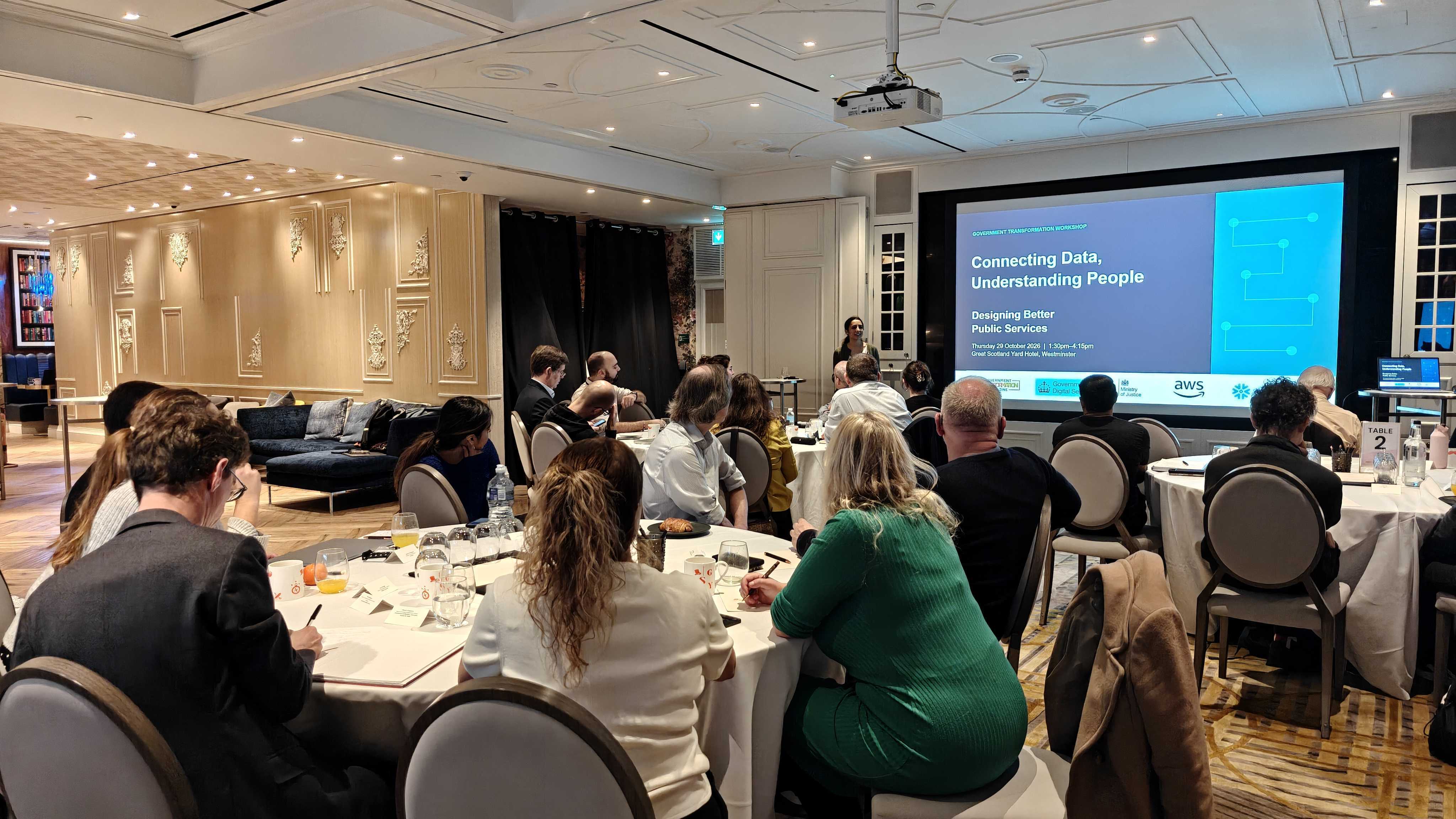
Civil servants attend Government Transformation Magazine's "Connecting Data, Understanding People: Designing Better Public Services" workshop, hosted in collaboration with the Ministry of Justice, Government Digital Service, Snowflake, and Amazon Web Services
With siloed government departments holding only fragments of information about people's lives, it can often be difficult to understand how a person’s past experiences can explain their present circumstances, or anticipate their future challenges. However, in failing to do so, government can miss out on opportunities for early intervention and better preparation.
This is the issue the cross-government BOLD (Better Outcomes through Linked Data) Partnership is out to resolve.
Led by the Ministry of Justice, BOLD brings together data, knowledge, skills and people from different government bodies (and beyond), to help tackle complex social challenges and inform improvements to public services. Its work ranges from linking datasets to developing reusable technology and sharing expertise.
Speaking to an audience of civil servants and public sector leaders at a workshop entitled “Connecting Data to Design Better Public Services” last week, Dr Nisha de Silva (Divisional Director, Cross-Government Division, MoJ) and Situl Gajjar (Head of Cross-Government Strategy and Transformation, Justice Data, MoJ) explained how the initiative was putting its approach into practice.
While initially established as a time-limited, centrally funded programme focused on proving the case for data linking through a small number of pilots, BOLD is now embedding its approach into departments, in an attempt to make cross-government collaboration a more ordinary part of governmental process.
Through collaboration with partners including the Department of Health and Social Care, the Ministry of Housing, Communities and Local Government, the Welsh Government, and local authorities, BOLD has been developing use cases for connecting particular data streams in ways which would achieve wider cross-departmental aims.
Starting from these use cases, the team then seeks to establish legal bases for data sharing, while following the principle of “least privileged access”.
BOLD’s four initial areas of focus centred around reducing reoffending, supporting victims of crime, countering substance misuse, and improving outcomes for those experiencing homelessness. They emphasised that all of these issues are interconnected.
Nisha de Silva explained this point by giving the example of a man, John, who ends up in prison after a complex childhood in which he is raised in poverty, taken into care, has his special needs missed at school, then finds himself expelled from college in teens with limited job prospects.
“By trying to push government to see this whole picture we can intervene early, where before we were having to build expensive prison places to give John a place in a prison,” she said.
One challenge BOLD is tackling is improving support for children with a parent in prison. Their first step was to develop an estimate of how many of such children there are, with data about them being dispersed across the Ministry of Justice, the Department for Education, and the Department for Work and Pensions.
They were able to achieve this through AI tooling and drawing on case notes - tools which also permitted them to gain a sense of the children’s characteristics. Following this they began working with local authorities to identify who these children are, and how to improve outcomes for them.
Similarly, BOLD linked MoJ and health data in England to determine whether people referred to substance-misuse treatment as part of a community sentence were appearing in the health system, finding that only 60% of offenders referred appeared in the health data. The team then worked with those who had been through the programme, as well as frontline staff, to improve the referral process, introducing clearer explanations of the benefits of treatment and follow-up calls soon after referral.
Alongside its collaboration with the Welsh Government on a range of substance misuse projects at a devolved nation level, the speakers emphasised the importance of its work with local authorities, which manage many crucial frontline services but do not necessarily have access to the information held by central government.
In one project, BOLD is working with the London Borough of Barking and Dagenham to test a model for local-national enabled delivery which is becoming increasingly important as central government continues to drive forward devolution measures to place greater emphasis on local decision-making.
For Situl Gajjar, BOLD's experience offers lessons that extend beyond data sharing itself.
One is the importance of sharing expertise, including knowledge of how to undertake data-linking projects and use the tools involved. It is to this end that BOLD has established a space on the Knowledge Hub collaboration platform, bringing together central and local government professionals to exchange lessons from their projects, share ideas how to tackle current systematic issues and share best practice.
To aid its work, BOLD has also helped develop and embed “Splink” and “Laurium”, tools which can be reused across government. Splink is an open-source software tool which helps identify when records with slightly different details may belong to the same person through probabilistic matching. Laurium, on the other hand, is a free text extraction tool for case management systems.
Yet Gajjar emphasised that sharing data and technical expertise is only part of the challenge. Equally important is ensuring that transformation is designed around the people it is intended to benefit, with service design, evaluation and impact analysis embedded from the outset. Likewise, the importance of coalescing around common outcomes and objectives, working as one-team and looking beyond organisational boundaries is core to future government delivery.
“It's critical to work with your end users, and service design is a big part of that puzzle,” he said.
He added: “It's a complete cultural shift to how the government naturally works.”