


NAO chief urges Whitehall to pair AI with cost transparency to unlock government productivity
 James
James
Gareth Davies, Comptroller and Auditor General of the National Audit Office (NAO), has urged Whitehall to treat cost transparency as a prerequisite for realising the productivity upside of AI and digital transformation, warning that public services will struggle to earn public confidence unless they can show how new technology translates into better outcomes for citizens.
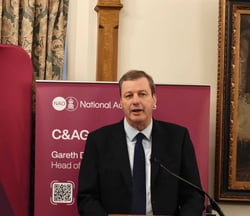 Speaking in Parliament for his 2026 annual address, Davies told the audience it is “a critical time for those of us focused on getting better results for citizens from the available public resources”, arguing that “too many public services remain difficult to use and expensive to deliver”. Against “historically high levels of taxation and borrowing”, he said, “the task of improving value for money” has become more pressing, and with it “the need for independent evidence-based auditing and public trust”.
That focus on trust and outcomes picked up directly from Davies’ 2025 speech, where he told public sector leaders the challenge was not simply adopting new technology, but “how to maximise the benefits whilst managing the risks” of AI, and warned it “would be a mistake to rely on technology to drive higher productivity”. This year, he returned to the same core argument, with sharper emphasis on a missing enabler: financial management that supports operational decision-making, not just compliance.
Digital productivity depends on cost visibility, not just new tools
Davies said the NAO’s latest five-year strategy puts “trust, value and impact at the heart of everything we do”, and sets “a new level of ambition”. The goal is explicit: “We want our work to help improve productivity and resilience… In short, we want to make a difference.”
While he welcomed progress across several long-running value-for-money themes, including project governance reforms, a 10-year infrastructure pipeline, and the potential of the Procurement Act to improve competition, Davies positioned digital transformation as one of the most significant levers for public sector productivity, but only if government tackles fundamentals.
“Digital Transformation offers huge opportunities to modernise the delivery of public services, making them easier to use and cheaper to deliver,” he said. But he immediately coupled that with a familiar NAO caveat: “Real productivity gains can’t be achieved without fundamentally reviewing business processes and improving data quality.”
That line closely echoes his 2025 warning, delivered in the context of AI adoption. The question was “not whether AI will make a difference but how to maximise the benefits whilst managing the risks”, and government should not expect technology alone to do the heavy lifting. In 2026, the language is less about aspiration and more about implementation discipline, particularly around the financial reality of digital operating models.
Cost structures, he noted, are changing. “What used to be periodic capital investments in new software, now we have annual services on the resource budget.” The practical challenge for departments is no longer buying technology, but proving it is delivering. “Who is ensuring that all these Copilot licences are starting to deliver the productivity gains expected to set against additional cost?” he asked.
Helping managers manage
The centrepiece of Davies’ 2026 speech was what he called a needed “step change in financial management”, framed as the unlock for better value for money and improved citizen outcomes.
He began with a point that will resonate with delivery leaders used to operating under tight controls. Government is good at budgeting and compliance, but weaker at turning financial insight into improved performance. “Soon after the Spending Review announcement, we published a report called Improving government’s productivity through better cost information,” he said. Its headline finding was that “managers often don’t have access to the activity cost information they need to drive efficiency and performance”.
Davies’ critique was blunt: “Government systems are too often set up to control spending within budgets, but not to help managers manage.”
Without a grip on the economics of delivery, he argued, operational choices become guesswork. “If the unit cost of delivery and the components making it up aren’t well understood, it’s difficult to make good operational decisions,” he said, before adding, “How do you know where the biggest bang for the buck is? How do you identify the efficiencies available?”
He linked the same weakness to public charging models. In an NAO report on fees and charges, he said, departments were breaching policies that require fees to cover service costs “because costs weren’t well understood”. The outcome is not simply technical non-compliance. “The effect is to transfer unplanned cost burdens to taxpayers and to reduce pressure on the department’s concern to manage costs.”
For DDaT leaders, the implication is that digital transformation cannot be treated as a standalone portfolio. It must be tied to a measurable unit-cost story: what changes, what it costs, what capacity is released, and what outcomes improve.
Partnering delivery, not policing it
Davies also pushed back against the idea that better financial management is synonymous with bureaucracy. “Financial Management is not just about compliance, it’s how better results are delivered,” he said, describing the “hearts and minds” challenge of culture change, with “a clear tone from the top and a credible narrative of the achievements made possible by a better grip on the money”.
One example he highlighted as best practice came from HMRC. In the Border Change Delivery Unit, he said, finance teams “partner the business to great effect” by “coaching and upskilling budget holders and building accountability for financial management across the business”. The result is operationally meaningful: “better planning and forecasting and better operational decisions”.
Asked how HMRC achieved that, Davies described a “concerted effort to improve the financial literacy of the managers” and help them understand “the dynamics of the business in financial terms”. The payoff is avoiding both wasteful end-of-year spend and underspends that deprive services of value. It is about “having really robust understanding of the finances through the year”.
The message for Whitehall is that productivity programmes relying on digital change need to embed finance capability into day-to-day delivery decisions, and that cutting specialist finance expertise as part of efficiency drives may be a false economy. “The challenge of transforming services and business processes and delivering real efficiency improvements requires more rather than less of these high level skills,” Davies said. “It’s not a question of headcount with expertise.”
AI: productivity prize vs trust risk
Davies used the later part of his speech to look ahead at “rapidly changing risks and opportunities”, focusing on defence, AI, and system-wide improvement. On AI specifically, he said the NAO will update its earlier work on identifying use cases and whether “expected benefits and service quality are being realised”.
He offered a concrete example from NAO work on police productivity. “The use of AI enabled tools for redacting sensitive information from videos, CCTV and audio has saved significant time for police officers,” he said, with “the potential to save over 11,000 days a month if adopted nationally”.
But he also stressed that trust is fragile. “Of course, we’re also seeing plenty of evidence that AI comes with risks to accuracy,” he said, and those risks “must be managed if public trust is going to be secure”. He framed it even more starkly: “There is no such thing as risk free application in this technology.”
To illustrate the trade-off, he referenced HMRC’s earlier experimentation with data matching to reduce fraud and error in child benefit, a case where “lots of innocent people were dragged into the net unnecessarily”. His concern was not to discourage innovation, but to force government to professionalise it. “That must not discourage the innovation… We just have to get better at doing it more accurately.”
How the NAO is using AI
Davies shared that audit is a sector where AI could “make the biggest impact”, because it involves “looking at large amounts of data and assuring the accuracy of the data”.
For now, he said the NAO is still “in the foothills”, using machine learning to speed routine tasks, such as “comparing an invoice to a ledger entry… many times faster than it was when that was a purely human process”.
The direction of travel, however, is profound, moving away from sampling and towards full-population analysis. “Where this is heading is the end of old fashioned audit sampling, towards analysis of the entire transaction population,” he said, raising new questions about how auditors assure those approaches.
He also described AI as introducing a new 'trust' question: “Can I trust the algorithms making decisions about service provision, benefit claims?” That, he implied, will become a core part of NAO scrutiny as AI moves from back-office automation into citizen-facing decisions.
Outcomes first: the flood defence example
Davies repeatedly returned to outcomes as the anchor for productivity and trust, offering an example designed to show what “better grip on the money” looks like in practice.
In 2020, he said, he qualified the Environment Agency’s annual accounts because it could not support the valuation of flood defence assets, due to weak condition data. New leadership made fixing that “a high priority”, overhauling the data so managers had “meaningful information on asset condition to inform maintenance”. The result was not only improved accounting. “The financial resources available for flood defences are being targeted more efficiently.” That translates directly into citizen outcomes: “more people, homes and businesses protected from flooding”.
“I can’t think of a better example of why good financial management matters,” Davies said.
A joined-up agenda for Whitehall
For departments under pressure to deliver savings while modernising services, Davies’ combined message across 2025 and 2026 is clear. AI and digital tools are necessary but not sufficient. Productivity gains require process redesign, data quality, skilled leadership, and cost transparency that lets government prove what is working and scale it.
Summing up his 2026 address, Davies said it has “never been more important to ensure that every penny of public money is achieving the maximum possible” for national security, prosperity, and quality of life. To do that, government must “improve digital and financial skills and modernise services so that [they are] easier to use and cost effective”.