


Getting AI moving: how central government is shifting from pilots to production
 Tim Coulthard

Central government has moved beyond early experimentation with artificial intelligence. While most departments now run multiple pilots, the priority has shifted to scaling these into operational services that deliver measurable impact.
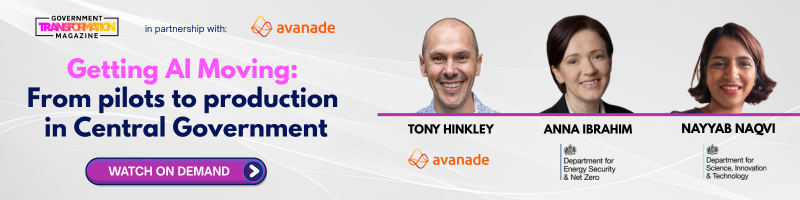
In our recent webinar, Getting AI Moving: From Pilots to Production in Central Government, senior leaders from the Department for Energy Security and Net Zero (DESNZ), the Department for Science, Innovation and Technology (DSIT), and Avanade examined how organisations are approaching that transition.
The discussion, produced in partnership with Avanade, highlighted a common challenge. AI is no longer scarce or novel. The constraint lies in delivery models, governance, and the ability to demonstrate value at scale.
From pilots to portfolios: industrialising AI delivery
A consistent theme across the panel was the need to move away from fragmented experimentation towards coordinated portfolios of use cases.
Anna Ibrahim, Chief Data Architect at DESNZ, described how many departments are still developing isolated initiatives driven by local teams. While these projects can demonstrate potential, they do not easily scale. She noted that “innovation hubs… are fostering their own little pet projects”.
Her approach has focused on establishing strong data foundations. This includes structuring and modelling departmental data so that it can support multiple AI use cases, rather than being tied to individual projects. Without this groundwork, even promising pilots struggle to progress.
Tony Hinkley, Chief Technology Officer at Avanade UK, reflected on a similar journey within his organisation and similar observations working with public sector partners. Early adoption of AI tools led to widespread experimentation but also duplication of effort, so Avanade responded by creating shared collaboration spaces, curating use cases, and aligning activity to defined business outcomes.
A key shift was the introduction of value-based prioritisation. Teams were required to articulate the benefit of a use case before receiving support. As Hinkley explained, if that link to value was missing, “it went back into a backlog and needed to be refined”.
From a cross-government perspective, Nayyab Naqvi, Principal Technologist for AI Enablement in the Public Sector at DSIT, emphasised the importance of senior ownership and shared baselines. She highlighted the need to align AI initiatives to business challenges and to build a consistent understanding of value across departments. As she put it: “We really need to get that senior buy-in, then strategically understand how we are going to create a baseline of that value.”
Governance and assurance: enabling rather than slowing delivery
The panel agreed that governance remains a critical barrier to scaling AI, particularly where existing processes are not designed for rapidly evolving technologies.
Hinkley outlined an approach that focuses on principles rather than prescriptive controls. Instead of attempting to govern individual tools, organisations define acceptable risk levels and decision frameworks. This allows teams to move quickly while remaining within clear guardrails.
He also stressed the role of capability building. Without a baseline level of understanding across staff, governance frameworks become difficult to apply in practice. Attempting to keep pace with every new tool is not sustainable, he suggested.
However, gaps in assurance frameworks persist. Ibrahim highlighted the difficulty of applying AI in sensitive areas such as recruitment, where ethical considerations are not yet fully defined. “The technology is developing at such a speed, the ethics processes are not catching up - there is a gap,” she said.
This uncertainty can lead to hesitation and underuse of available tools. Naqvi outlined how DSIT is addressing this by extending existing service assurance models. Rather than creating entirely new frameworks, the department is integrating AI into established processes and introducing continuous monitoring. This includes developing tools to assess risks such as bias and fairness, while allowing departments to tailor controls to their specific contexts.
Across the discussion, there was broad agreement that governance must evolve alongside delivery. Waiting for complete certainty risks delaying progress indefinitely.
Demonstrating value: from experimentation to impact
Sustaining investment in AI requires clear evidence of operational and financial value.
Ibrahim pointed to areas such as fraud detection as high-impact opportunities. She referenced estimates that 6% of public spending is lost to fraud, and highlighted the potential for AI to identify patterns across complex datasets. However, she stressed that this depends on having the right data structures in place.
Hinkley argued that value must be communicated in business terms. Senior stakeholders are less concerned with the underlying technology and more focused on outcomes. “Most of the senior stakeholders neither know nor care about the technology. What they care about is the outcome,” he said.
This requires a disciplined approach to defining success. Each use case should include a clear hypothesis and measurable indicators, enabling organisations to track impact over time.
Naqvi described how DSIT is applying this in practice. Teams begin by establishing baseline metrics, such as call handling times or customer wait times, before introducing AI solutions. By comparing performance before and after deployment, departments can demonstrate tangible improvements and build the case for further investment. As she noted: “You need to showcase the value, then you will be able to secure the finances needed to scale.”
Lessons learned: balancing pace, risk, and foundations
Reflecting on their experiences, the panellists highlighted several priorities for organisations at earlier stages of adoption.
Ibrahim pointed to the need for greater consistency in data modelling approaches across government. Shared standards could reduce duplication and accelerate progress.
Naqvi emphasised the importance of balancing delivery speed with appropriate controls. Organisations need to move beyond both excessive caution and uncontrolled experimentation. “Understand the balance between acceleration and assurance… not just risk aversion, but risk awareness,” she said.
Hinkley focused on organisational capability. In his view, success depends on investing in people as much as technology. “Education is much more important than the specific tools that you choose,” he said. He also highlighted the need to prioritise delivery, encouraging “progress over perfection - we have to start delivering outcomes” .
The discussion reflects a broader shift in government’s approach to AI. The challenge is no longer proving that AI can work, but embedding it into the core of public service delivery.
Achieving this requires coordinated portfolios of use cases, governance models that support delivery, and a clear focus on measurable outcomes. Departments that can align these elements are beginning to move beyond pilots and towards AI that delivers sustained, operational impact.
Event partner Avanade are offering a free two-hour Data & AI workshop where they will work with your team to identify the practical steps, data foundations and guardrails needed to scale AI responsibly.
Click here to request your workshop.



.jpg?width=600&name=Untitled%20design%20(49).jpg)