

AI-powered flood readiness model identifies over one million vulnerable buildings
 Maya Sgaravato-Grant
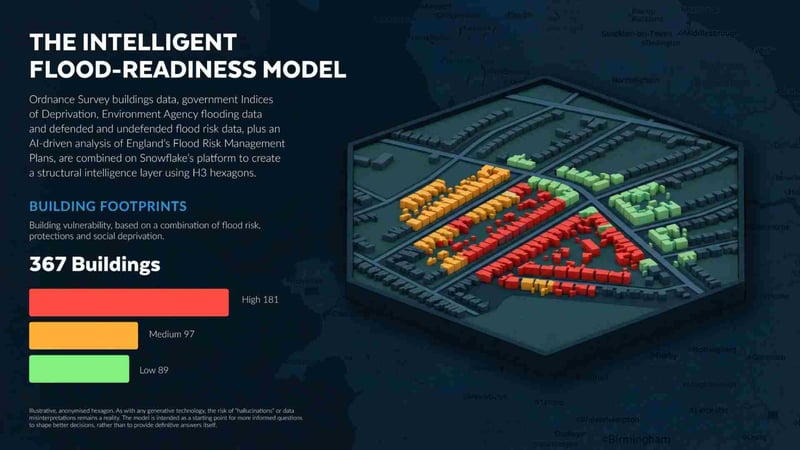
A new AI-powered data model has identified 1.2m buildings in England that are at risk of flooding, but not covered by existing flood defences.
The Intelligent Flood Readiness Model, built by Snowflake in collaboration with Ordnance Survey, combines the latter’s detailed building datasets with a range of government data and information on Flood Risk Management Plans to assess vulnerability at a national scale.
Through layering data on mapping, flood risk and social deprivation, the analysis also revealed that up to 68% of these 1.2m buildings are situated in deprived areas which may not possess the resources and social infrastructure to permit a swift recovery, leaving them exposed to the after-effects of flooding.
Tim Chilton, Managing Geospatial Consultant at OS, said he was excited to help local government better improve preparedness: “[T]he model provides insights into how well areas and properties are protected and where to prioritise investment in critical flood defences.
“By delivering geospatial intelligence difficult to derive manually, decision-makers can access data-driven, actionable insights - without the burden of analysing endless spreadsheets.
“The model maps vulnerable zones and identifies areas at greatest risk, helping local government shape policy, direct resources, and safeguard communities.”
The Intelligent Flood Readiness Model works by cross-referencing OS’ building datasets with the Indices of Deprivation in England, to build an understanding of the intersection between physically vulnerable housing and social precarity.
This is then layered against flood risk data from the Environment Agency, as well as AI-driven text analysis of government documents relating to flood risk management plans.
As England faces more frequent flooding, those working with the model have urged policymakers to consider five key recommendations. These include using similarly advanced models capable of sifting through granular data to factor in neighbourhood or individual building vulnerabilities when preparing for floods, understanding where there are clusters of vulnerability, and to look at surface water infrastructure investment. The model found that 85% of vulnerable and undefended buildings are at risk of surface water flooding, rather than the more obvious river or coastal flooding.
It also recommended that ‘vertical risk assessments’, factoring both the height and footprint of a building, be considered, and that policymakers should factor in social deprivation plans.
Fawad Qureshi, Global Field Chief Technology Officer at Snowflake, said: “Rather than relying on hindsight, static maps and fragmented datasets, we can turn the latest, highly granular data into a structural intelligence layer, and use AI to interrogate how effective current plans are likely to be.
“It’s not the final answer, but it can inform the next question, and help offer more protection to some of our most vulnerable neighbourhoods before the first drop of rain falls.
“This is a clear example of how organisations can combine real-time data, scalable compute, and advanced AI to simulate scenarios, stress-test plans, and continuously refine strategy, helping identify recommendations to protect communities with precision and confidence.”


Also Read
- Two startups selected for government pilots in first-of-its-kind Whitehall procurement competition
- British policing’s first AI crime reporting tool piloted in Cambridgeshire
- Beyond the pilot: Why the UK public sector needs an open source AI strategy
- Liverpool launches AI task force to drive ‘AI for Good’ ambitions